bitchat
- 4.0
- Rating
- 1.00M
- Installs
- Free
- Price

 Analysis by App-foxy
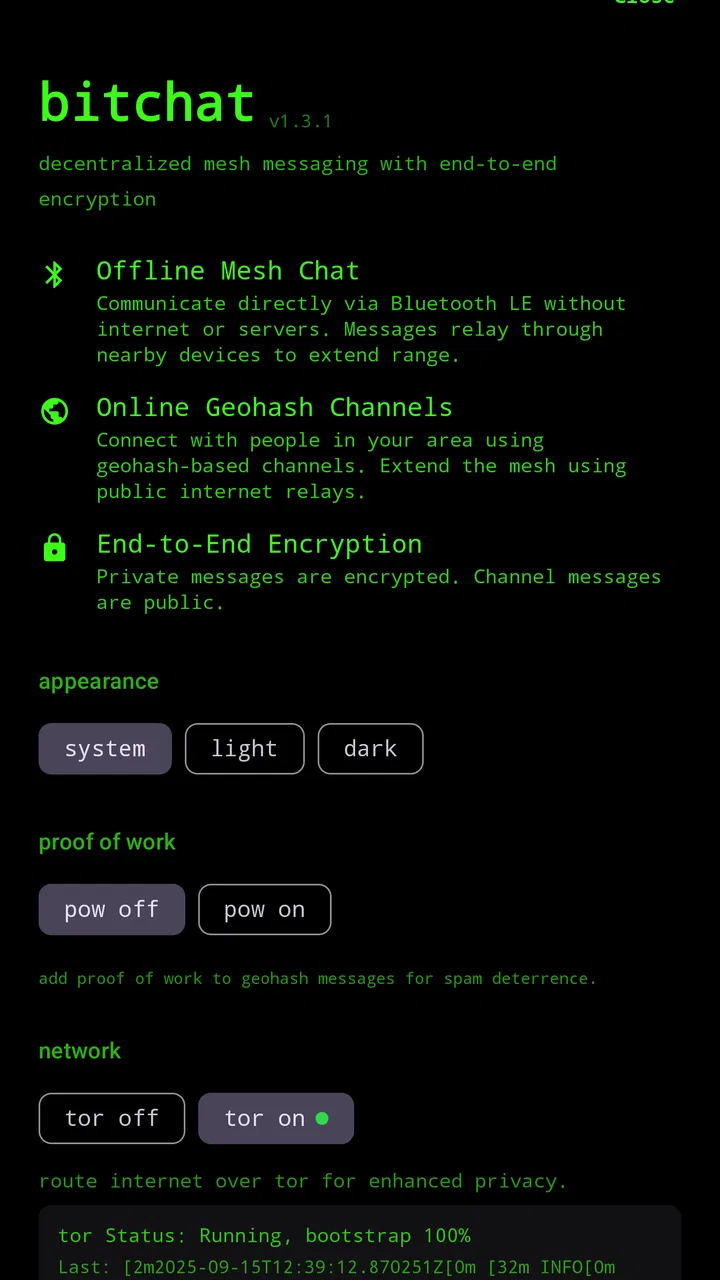
I approached bitchat as a communication app with a very different starting point from the usual messenger. Instead of treating the internet connection as the center of every conversation, it presents itself as a decentralized mesh chat tool. That idea immediately makes it interesting, but it also means you need to understand when its design is useful and when a conventional messenger will be more practical.
In my experience, the appeal is less about replacing every chat app on your phone and more about having another way to communicate when a normal centralized service is not the best fit. The app is free, aimed at Everyone, and developed by Verse Communication PBC. It has reached over a million installs and holds a 4.0 average from around three thousand ratings, which suggests that the concept has attracted real attention while still leaving room for mixed experiences.
How bitchat feels in its current form
The first thing I noticed is that bitchat asks me to think about messaging differently. With a familiar service, I normally choose a contact, type a message, and assume a remote server will handle the rest. A mesh-oriented app shifts that mental model toward nearby devices and local communication paths. That can be valuable in situations where ordinary connectivity is unreliable, unavailable, or simply not the communication method I want to depend on.
You May Also Like

 Blood Strike: 2.5 Anniversary
Blood Strike’s Loadouts Turn Every Drop Into a Tactical Gamble
A close look at Blood Strike’s custom loadouts: how fast access to signature weapons reshapes its battle royale rhythm, rewards preparation, and narrows the gap between fights.

 Pandora - Music & Podcasts
Pandora’s Music Is Easy to Start, but Harder to Recover
Pandora’s strength is its low-effort path from a seed to a station. Its weak spot is how much confidence it asks you to place in connection, setup, and quiet recovery.

 8 Ball Pool
 Is Built on Rivalries, Rematches, and Routine
A close look at the rivalries, rematches, shared routines, and unanswered safety questions that turn a quick pool match into a persistent mobile community.

 Samsung Music
’s Quiet Strength Is Playing What You Already Own
Its reach comes less from spectacle than from dependable access to a personal library. That simplicity is both the app’s strongest retention engine and its ceiling.

 AccuWeather: Weather Radar
AccuWeather Review: A Quick, Clear Forecast for Everyday Decisions
For everyday plans, the best forecast is the one you can understand quickly. AccuWeather makes rain timing, radar, and local conditions easy to act on, with a few trade-offs.

 Hill Climb Racing
Why Hill Climb Racing Still Turns Crashes Into One More Run
A tiny car, a bumpy hill and one more upgrade: Hill Climb Racing keeps resurfacing because its simple chaos makes every near-miss feel personal.
More From Our News Desk



This makes the app especially intriguing for small groups in the same physical area. Imagine a group of friends at an outdoor gathering where mobile service is congested, or people coordinating in a building where internet access is inconsistent. In that kind of setting, a decentralized approach can feel more purposeful than opening a standard messenger and waiting for a connection that may not cooperate.
There is an important trade-off, though. A mesh chat app is not automatically a universal replacement for services built around broad internet reach. If I need to contact someone across town, send a message to a family member in another country, or maintain a long-running conversation across changing locations, I would still reach for a conventional communication platform first. The strength here is situational communication, not effortless global messaging.
The current version is 1.7.1, and that number gives the product a more established feel than an early experiment while still suggesting an app that is actively developing. I would not interpret the version alone as a promise that every rough edge has disappeared. Instead, I see it as a sign that the team has moved beyond the first proof of concept and is continuing to shape how the experience works for ordinary users.
That distinction matters because decentralized communication is harder to make feel invisible. In a standard messenger, the infrastructure is mostly hidden. With bitchat, the way devices connect is part of the product’s identity. The result can be more empowering for technically curious users, but it may require more patience from someone who expects the same predictable behavior as a mainstream chat app.
The best everyday scenario is local coordination
A realistic use case is a group meeting at a crowded public event. Before arriving, I could encourage everyone to install the app and test it together. Once the group is nearby, it may provide a useful channel for short updates such as changing meeting points, finding someone who has wandered away, or telling others where the group has moved. The value is not that it makes a huge event magically simple; it is that the group has a communication option designed around proximity rather than a single distant service.
Another scenario is a temporary team working in the same place. Volunteers, event staff, or friends on a trip might use it for quick local coordination without turning every exchange into a public post or relying entirely on a cloud-based chat room. I like this kind of focused use because it matches the app’s unusual design instead of forcing it to behave like a clone of a familiar messenger.
My practical advice is to set it up before the moment when you desperately need it. A communication tool should not be introduced for the first time during a disruption. Have the people in your group install it, open it, and try a short exchange while everyone is together. That simple rehearsal helps reveal whether the app fits your devices, your environment, and your expectations.
What the current release means for existing users
For someone already using bitchat, version 1.7.1 is best viewed as the current reference point rather than a reason to assume a completely different product. The app’s central identity remains its decentralized mesh chat approach. Users who joined because they wanted a local, less conventional communication method should still recognize the same purpose when returning to it.
The broader sign of progress is that the project has had time to move through multiple iterations. That matters for an app whose success depends on making an unfamiliar communication model understandable. Every refinement in onboarding, reliability, message handling, or device interaction can reduce the gap between the idea and the everyday experience. I would pay attention to those practical improvements more than to flashy additions.
For new users, the release number also offers a useful expectation: this is not something I would install solely because the concept sounds clever and then judge after thirty seconds. The app deserves a small trial with the people I actually intend to contact. A mesh system’s usefulness depends heavily on context, nearby participants, and how smoothly the group adopts it.
The free price removes one obvious barrier to that experiment. I can test the app without first deciding whether an ongoing subscription is worth it. That is particularly helpful here because the question is not simply whether I like the interface. I need to discover whether the communication model fits my routines and the places where I expect to use it.
Where it differs from ordinary messengers
Comparing bitchat with a standard messenger is useful, but only if I compare the right qualities. Mainstream chat apps usually win at convenience: contacts are familiar, conversations are easy to resume, and remote communication is the default. They are better suited to keeping up with people who are spread across different places and time zones.
bitchat is more compelling when the physical relationship between users matters. Its mesh focus makes local presence part of the experience instead of treating it as irrelevant. That can make it a better fit for nearby coordination, experiments in decentralized communication, and users who do not want every conversation to depend on the same centralized pattern.
The trade-off is predictability. With a conventional service, I generally know what happens when I send something: the message travels through the provider’s infrastructure and appears on the recipient’s device when the service is available. A mesh-oriented workflow introduces more variables. Nearby devices, the surrounding environment, and the behavior of the participating group all become more important.
That is why I would not recommend replacing a dependable everyday messenger immediately. Keep the app as a complementary tool while you learn how it behaves in the places where you care about it. If it proves reliable for your group, it can earn a more central role. If not, you have learned an important limitation without losing access to your usual communication channel.
Small habits that make the experiment more useful
The first useful habit is group testing. Do not evaluate the app alone and assume that a successful installation proves the whole system works. The meaningful test involves at least the people you expect to contact, positioned in the kind of place where you would actually use local chat. This reveals whether the app feels natural to the group rather than merely interesting on an individual phone.
The second is to give conversations a clear purpose. A short coordination thread is easier to evaluate than an attempt to move an entire social history into a new platform. Try a specific task, such as arranging a meeting point or sharing a brief update among people nearby. That makes it easier to judge whether the app saves effort or adds another layer of confusion.
The third is to treat it as a backup channel until you understand its boundaries. I would not make it the only way to communicate an urgent plan before testing it under realistic conditions. This is not a criticism of the idea; it is sensible practice for any communication technology that depends on a different connection model from the one most people use every day.
A fourth insight is that adoption is part of the product experience. A decentralized chat tool can be technically appealing, but it has little value if the people around me do not install it or remember how to use it. The app is therefore better suited to groups willing to coordinate their tools in advance than to casual conversations with people who expect me to message them through whatever service they already use.
Who will appreciate it most
I think bitchat is a strong candidate for people who enjoy exploring alternative communication systems and want a local option for group coordination. It may also suit organizers, travelers, hobby groups, and technically curious users who are comfortable testing a tool before depending on it. The free entry point makes that exploration easier, and the Everyone content rating keeps the app broadly accessible.
It is also worth considering for someone who feels uncomfortable putting every communication need into one centralized ecosystem. The app’s decentralized identity is not just a technical detail; it changes the reason for installing it. If that principle matters to you, the learning curve may feel worthwhile.
On the other hand, I would skip it if my main requirement is effortless remote messaging with people who are unlikely to install another app. Someone who wants polished media sharing, a large established contact network, or a familiar cross-location conversation history may be happier with a mainstream alternative. The same is true for users who dislike testing new workflows or who need one guaranteed channel for important communication.
I would also be cautious about treating the app as a complete emergency solution without first practicing with the intended group. A different communication architecture can be useful during connectivity problems, but usefulness depends on the actual circumstances. Installing it is easy; building confidence in it requires hands-on testing.
Remaining friction in the experience
The biggest challenge is the expectation gap. Many people hear “chat app” and assume they can message anyone, anywhere, at any time. bitchat’s mesh emphasis points toward a more local and context-dependent experience. If the app does not explain that distinction clearly enough during setup, newcomers may judge it unfairly because they are asking it to solve the wrong problem.
There is also a social friction that no interface change can completely remove. A communication app works best when other people are present and prepared to use it. Convincing a group to add a separate tool takes effort, especially when everyone already has a preferred messenger. The app therefore needs a specific reason to exist in a group’s routine, not just a general promise of being different.
Reliability expectations create another tension. A conventional messenger hides most of its infrastructure, while a decentralized system makes the surrounding conditions more relevant. That can be a strength for users who want a more distributed approach, but it may feel inconsistent to someone who expects the same behavior in every location.
These limitations do not make the app unhelpful. They define the audience more clearly. I would judge it by whether it performs its local communication role well, not by whether it matches every convenience feature of a mature internet-based platform.
What I would watch as the app evolves
Future progress should be measured by how quickly a first-time user can understand the app’s purpose and complete a useful group exchange. Clear guidance, sensible setup, and confidence during real local use would matter more to me than simply adding a longer feature list. The product has an unusual idea; its next challenge is making that idea approachable without flattening what makes it different.
I would also watch whether the experience becomes easier for groups to adopt repeatedly. A one-time experiment is interesting, but a communication tool becomes valuable when people remember to use it for the next gathering. Improvements that reduce setup hesitation, clarify who is reachable, and make local coordination feel natural could have a larger effect than cosmetic changes.
Existing users should pay attention to how each update affects practical trust. If the app is going to serve as a secondary channel during difficult connectivity situations, people need a straightforward way to learn its behavior before relying on it. The most important evolution will be the one that turns curiosity into dependable habits while preserving the decentralized character that brought users to it.
My recommendation after using it
I see bitchat as a purposeful communication experiment that can become genuinely useful when the people, place, and reason for chatting all line up. I like that it does not simply repeat the standard messenger formula. Its mesh approach gives it a distinct role, especially for nearby groups that want another way to coordinate.
My recommendation is to install it as a companion rather than an immediate replacement. Test it with friends or teammates in a real local situation, use it for a defined task, and compare the effort with the tools you already know. If your needs center on global, always-available messaging, a conventional app will probably remain the better choice. If you want a free, different approach to local communication and are willing to learn its boundaries, this app is worth exploring.
With its current version at 1.7.1, a 4.0 average, and more than a million installs, it has enough momentum to deserve attention without pretending that every use case is solved. Verse Communication PBC has created something that asks users to participate in the communication model rather than merely consume it. For the right group, that is the reason to try it; for everyone else, it is the clearest reason to keep expectations realistic.
FAQs for bitchat
01What is BitChat and how does it work?
BitChat is a secure messaging app designed to prioritize user privacy. It uses end-to-end encryption to ensure that your messages remain private and only accessible to the intended recipient. With a user-friendly interface, it allows you to send text, voice, and video messages seamlessly. Ideal for those seeking a secure communication platform.
02Is BitChat free to use?
Yes, BitChat offers a free version that includes essential messaging features. However, it also provides a premium subscription with additional functionalities such as enhanced security options, customizable themes, and larger file sharing capabilities. Users can choose based on their needs and preferences.
03What platforms is BitChat available on?
BitChat is available on both Android and iOS platforms. It is designed to offer a seamless experience across devices, ensuring that you can stay connected whether you're using a smartphone or a tablet. Regular updates ensure compatibility with the latest operating system versions.
04How secure is BitChat for protecting my data?
BitChat employs industry-standard end-to-end encryption to protect your messages from unauthorized access. This means that only you and the person you're communicating with can read the messages. Additionally, BitChat does not store your messages on their servers, further enhancing privacy.
05Does BitChat offer group chat functionality?
Yes, BitChat supports group chats, allowing you to communicate with multiple people at once. You can create groups for friends, family, or work, and enjoy features like group video calls, file sharing, and collaborative chat tools. Group management options are also available to organize and control chat settings.
Pros
- User-friendly interface for easy navigation.
- Secure messaging with end-to-end encryption.
- Customizable themes and chat settings.
- Supports multimedia sharing
- including GIFs.
- Group chat features for team collaboration.
Cons
- Limited language support might be an issue.
- Occasional lag in message delivery.
- Requires stable internet for optimal use.
- No desktop version available currently.
- Some features hidden behind paywall.

bitchat
Gallery